

Best Coffee Brewing Gear for Beginners (2026 Picks)
Table of Contents
- Best Coffee Brewing Gear for Beginners: Quick Comparison
- Why the Grinder Matters Most (And How to Choose)
- Start Simple: The Best Automatic Drip Coffee Maker
- Learn the Craft: Essential Pour-Over Coffee Brewing Tips
- The Ultimate Beginner Immersion Brewer: AeroPress
- Espresso on a Budget: The Breville Bambino Plus
- How to Choose a Coffee Scale for Consistent Brews
- Avoid These Common Beginner Mistakes
- Frequently Asked Questions
Last Updated: September 8, 2026
Many beginners buy a flashy espresso machine first and end up drinking bitter shots from stale pre-ground beans. The single most important purchase for great home coffee is not the brewer at all, but the grinder that feeds it. At Johnny D's Brew, we roast to order for maximum flavor, and we know that the best coffee brewing gear for beginners focuses on freshness and consistency before anything else.
This guide breaks down the essential coffee brewing gear for beginners into clear categories, covering what to buy, what to skip, and where your money changes the taste.
Quick Picks:
- Best Overall Grinder: Baratza Encore, the gold standard for entry-level grinding
- Best Automatic Option: OXO Brew 9 Cup, SCA-certified brewing without the effort
- Best Manual Starter: AeroPress Original, forgiving, fast, and portable
- Best for Espresso Later: Breville Bambino Plus, compact and beginner-friendly
Best Coffee Brewing Gear for Beginners: Quick Comparison
Choosing the right starter gear comes down to how much hands-on time you want each morning. The comparison below sorts the top beginner options by brewing style, effort level, and price point.
| Gear | Brewing Style | Effort Level | Best For |
|---|---|---|---|
| OXO Brew 9 Cup | Automatic drip | Very low | Consistent daily coffee without fuss |
| Hario V60 | Manual pour-over | High | Learning the craft of extraction |
| Kalita Wave 185 | Manual pour-over | Medium | Forgiving flat-bottom pour-over |
| AeroPress Original | Immersion + pressure | Low | Fast, portable single cups |
| Breville Bambino Plus | Espresso | Medium | Milk-based drinks at home |
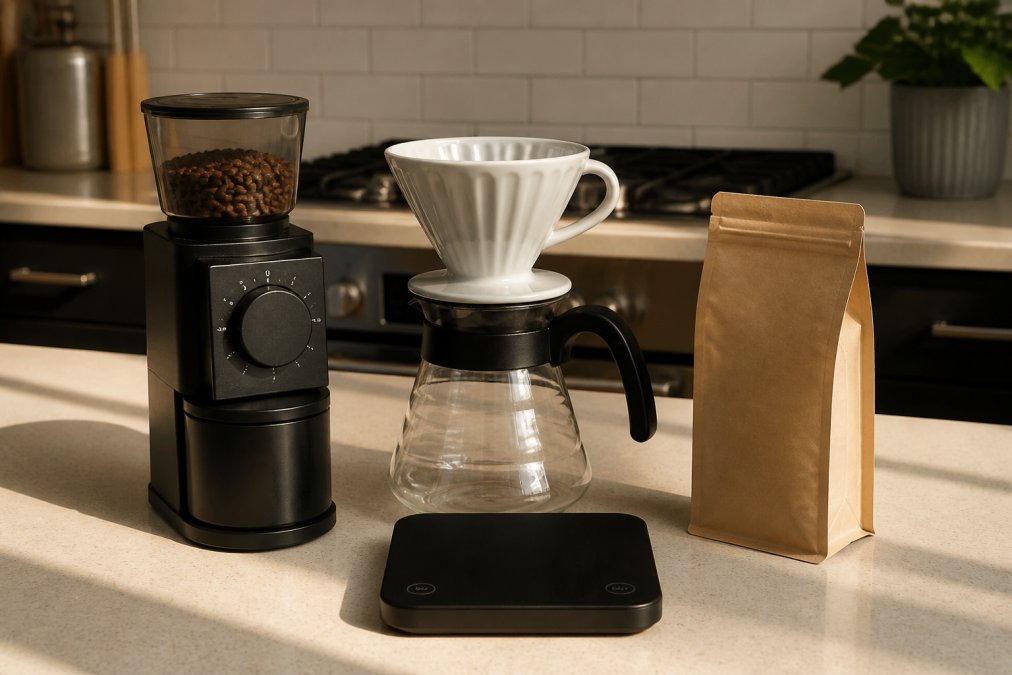
Why the Grinder Matters Most (And How to Choose)
The grinder is the most important piece of coffee brewing gear because it controls extraction. Coffee grounds that vary wildly in size extract unevenly, producing a cup that is simultaneously sour and bitter.
Blade grinders chop beans into random fragments, which ruins the cup. Burr grinders crush beans between two abrasive surfaces to produce uniform particles. For beginners, a conical burr grinder offers the best balance of price and grind consistency.
Best Burr Coffee Grinder for Beginners: Baratza Encore
The Baratza Encore is the benchmark entry-level conical burr grinder, offering 40 grind settings from French press to pour-over (baratza.com). Its high-torque DC motor and hardened steel burrs stay sharp for years.
What makes the Encore ideal for beginners is its simplicity: just an on/off switch and a hopper. When you are ready to upgrade, Baratza sells replacement parts, so the grinder is repairable rather than disposable.
Start Simple: The Best Automatic Drip Coffee Maker
Manual brewing is rewarding, but some mornings you just want to press a button. The OXO Brew 9 Cup Coffee Maker delivers SCA-certified brewing quality without requiring any skill.
The Rainmaker showerhead distributes water evenly, preventing channeling. A double-wall stainless steel thermal carafe keeps coffee hot for hours without a burner. The machine offers both single-serve and full-carafe modes.
The tradeoff is counter space; measure your kitchen before committing. If you have limited room, a manual method may serve you better.
Learn the Craft: Essential Pour-Over Coffee Brewing Tips
Pour-over brewing is the best way to understand how water, time, and grind size shape flavor. The payoff is a clean, bright cup that highlights the subtle notes of single-origin beans.
Start with a proper ratio: 60 grams of coffee per 1,000 grams of water (sca.coffee). The bloom is the first pour, using about twice the weight of the coffee in water to release trapped carbon dioxide. Let it sit for 30 to 45 seconds, then continue pouring in slow, circular motions.
Hario V60 vs. Kalita Wave vs. April Brewer
The Hario V60 is the classic conical dripper with spiral ribs and a single large hole, producing a clean, bright cup but demanding a steady hand and gooseneck kettle. If you want to master the craft, this is the dripper to learn on.
The Kalita Wave 185 uses a flat-bottom design with three small holes, slowing flow and making extraction more forgiving. Its flat bed reduces channeling risk, but proprietary wave filters can be harder to find locally, so stock up online.
The April Plastic Brewer is a modern, forgiving flat-bottom alternative producing a balanced cup. Its lightweight plastic construction is durable and affordable, though it requires specific filters not found in every grocery store.
| Dripper | Shape | Difficulty | Cup Profile | Filter Type |
|---|---|---|---|---|
| Hario V60 | Conical | Harder | Clean and bright | Standard V60 paper |
| Kalita Wave 185 | Flat-bottom | Moderate | Balanced and sweet | Proprietary wave paper |
| April Brewer | Flat-bottom | Moderate | Forgiving and even | Specific flat-bottom paper |
The Ultimate Beginner Immersion Brewer: AeroPress
The AeroPress Original is the most forgiving coffee brewing gear a beginner can buy. It combines immersion brewing with air pressure to extract coffee quickly, making a bad cup nearly impossible.
The AeroPress uses a BPA-free plastic chamber where coffee steeps before being pushed through a paper filter by air pressure (aeropress.com). The result is a smooth, full-bodied cup with low acidity. Cleanup takes seconds, and the unit weighs almost nothing, making it a top choice for travel.
Its main limitation is single-cup brewing; pair it with a larger brewer if you regularly serve guests.
Espresso on a Budget: The Breville Bambino Plus
Espresso is the most demanding brewing method, but the Breville Bambino Plus makes it accessible. This compact machine heats up in 3 seconds, and PID temperature control keeps water stable for consistent extraction.
The automatic steam wand produces microfoam for latte art without barista-level technique, and low-pressure pre-infusion reduces channeling. If you want espresso-based drinks without a $1,000 machine, this is the entry point.
The lightweight build can slide on the counter when locking in the portafilter. Pair it with a grinder capable of fine espresso settings, since pre-ground coffee will not produce acceptable shots.
How to Choose a Coffee Scale for Consistent Brews
A digital scale is the cornerstone of repeatable brewing. Measuring by volume is unreliable because bean density and grind size change the weight of a scoop. A scale with 0.1-gram precision lets you hit the same brew ratio every morning.
What to Look For in a Scale
- Precision: 0.1-gram resolution is non-negotiable for dialing in espresso later. For pour-over and AeroPress, 1-gram precision is acceptable, but 0.1g future-proofs your setup.
- Built-in Timer: Timing your pour is as important as weighing your dose. A scale with an integrated timer eliminates the need for a separate phone app or stopwatch.
- Tare Function: This allows you to zero out the weight of your brewer and measure coffee and water separately. Ensure the tare button is responsive and easy to press with a carafe on the scale.
- Size and Footprint: A scale that is too large will not fit under your espresso machine's portafilter. Measure your drip tray clearance before buying. For pour-over, a slim profile is easier to place next to your dripper.
- Battery Life and Charging: Many scales use USB-C now, but some still rely on AAA batteries. A scale that dies mid-pour ruins your workflow. Look for one with a low-battery indicator.
The Hidden Cost of Water Filtration
Your tap water can sabotage your brewing more than any gear choice. Minerals in hard water scale your kettle, while heavily chlorinated water makes coffee taste flat. A simple carbon filter pitcher (like a Brita or PUR) is the most cost-effective solution.
- Initial Cost: $20 to $40 for a basic pitcher.
- Ongoing Cost: $6 to $10 per replacement filter, typically needed every 2 to 3 months.
For serious consistency, a dedicated water recipe using distilled water and mineral packets (like Third Wave Water) adds complexity rarely necessary for a beginner.
The Hidden Cost of Cleaning Supplies
Coffee oils and mineral deposits accumulate quickly. Neglecting to clean your gear will make coffee taste bitter and shorten equipment lifespan. Budget for these consumables from day one:
- Grinder Cleaning: Grind a few tablespoons of Grindz (an edible, tablet-style cleaner) through your burr grinder every 4 to 6 weeks. A small container costs around $12 and lasts several months. You will also need a small brush (often included with your grinder) to sweep out the burr chamber.
- Descaling Solution: For any machine with a boiler or heating element (drip makers, espresso machines), use a food-grade descaler like Urnex Dezcal every 1 to 3 months, depending on your water hardness. A bottle costs about $10 and provides multiple treatments.
- Replacement Filters: Paper filters for pour-over and AeroPress are a recurring cost. A pack of 100 V60 filters costs about $8 to $10. AeroPress filters are similarly priced. If you brew one cup daily, that is roughly $3 per month in consumables.
The Hidden Cost of Replacement Parts
Cheap gear is often disposable. When a $20 blade grinder dies, you replace the whole unit; when a $150 Baratza Encore has an issue, you can buy a replacement burr set for $20 to $40 and repair it in 15 minutes. This repairability differentiates budget from value gear.
Before buying any brewer, check if the manufacturer sells spare parts. Baratza is famous for this; many cheaper drip machines do not offer parts, turning a failed heating element into landfill.
Avoid These Common Beginner Mistakes
The most common beginner mistake is buying stale, pre-ground coffee. Grinding fresh beans immediately before brewing preserves volatile aroma compounds that dissipate within minutes. Roasted-to-order beans make a measurable difference.
Another frequent error is using the wrong grind size. Espresso requires fine, pour-over medium, and French press coarse; the wrong size leads to over- or under-extraction, ruining flavor.
A third mistake is neglecting the ratio. Guessing at coffee and water amounts produces inconsistent results; weighing both takes 10 extra seconds and guarantees you can replicate a good cup.
Sour Coffee? You Are Under-Extracting
Sour, sharp, or salty flavors mean your brew is under-extracted. The water did not pull enough soluble flavor and sweetness from the grounds. The fix is almost always one of three adjustments:
- Grind Finer: This is the first lever to pull. On a Baratza Encore, move 2 to 3 settings finer (e.g., from 18 to 15). The finer particles increase surface area, allowing water to extract more.
- Increase Brew Time: If you are using an AeroPress, press more slowly (30 seconds instead of 15). For pour-over, pour more slowly in smaller circles to extend the total brew time.
- Raise Water Temperature: If your water is below 195°F, extraction slows dramatically. Use a thermometer to verify your kettle's actual temperature.
Bitter Coffee? You Are Over-Extracting
Bitter, dry, or astringent flavors mean you are pulling too much out of the coffee, including the harsh compounds that come last. The fix is the opposite of the above:
- Grind Coarser: Move 2 to 3 settings coarser on your grinder. This reduces surface area and slows extraction.
- Shorten Brew Time: For a V60, if your drawdown (the time from your last pour to when the bed is dry) exceeds 3 minutes, your grind is too fine. Aim for 2:30 to 3:00 total brew time.
- Lower Water Temperature: If you are using boiling water (212°F), let it rest for 30 to 45 seconds to drop into the 200°F range.
The 'Channeling' Problem in Pour-Over
If your pour-over tastes hollow or inconsistent, you may have channeling. This happens when water finds a path of least resistance through the coffee bed, over-extracting that path while leaving the rest dry. The fix is in your pouring technique:
- Pour in Slow, Tight Circles: Start at the center and spiral outward, keeping the stream small and controlled. Do not pour directly onto the paper filter walls.
- Keep the Bed Level: After your bloom pour, give the brewer a gentle swirl to ensure all grounds are saturated and level. An uneven bed creates weak spots.
- Use a Gooseneck Kettle: A standard kettle pours too fast and with too much force. A gooseneck kettle (like the Fellow Stagg or Hario Buono) gives you the control needed to avoid disturbing the bed.
The Espresso 'Sink Shot' Fix
If you have moved to espresso and your shots run too fast (under 20 seconds) or too slow (over 35 seconds), do not change the machine. Change the grind. A fast, thin shot means grind finer. A slow, drippy shot means grind coarser. Adjust one setting at a time and pull another shot. This iterative process is called 'dialing in.'
Frequently Asked Questions
What is the best coffee equipment for a beginner?
For most beginners, a quality burr grinder and a simple immersion brewer like the AeroPress offer the best balance of cost, ease, and great coffee. The AeroPress is forgiving of technique and easy to clean. If you prefer a hands-off morning, an SCA-certified automatic drip maker like the OXO Brew 9 Cup produces consistent results. Add a digital scale and fresh beans from a roaster like Johnny D's Brew to complete your starter set.
Do I need a burr grinder for better coffee?
Yes. A burr grinder is the single most impactful upgrade you can make. Blade grinders chop beans unevenly, leading to bitter and sour flavors in the same cup. Burr grinders, like the Baratza Encore, crush beans between two surfaces for a consistent particle size. This consistency, or grind consistency, is key for proper extraction. You'll taste the difference immediately, even with budget-friendly beans.
What is the 15-15-15 rule for coffee?
The 15-15-15 rule is a simple memory aid for AeroPress brewing. It means using 15 grams of coffee, 15 clicks on the grinder (a medium-fine setting), and a 15-second stir after adding water. It's a great starting point for beginners because it's easy to remember and produces a balanced cup. Adjust the grind or steep time to suit your taste once you master the basics.
What is the 80/20 rule for coffee?
In coffee, the 80/20 rule is often used loosely to describe the impact of your equipment versus your beans. A common interpretation is that 80% of your final cup's quality comes from the beans themselves, and only 20% comes from your brewing gear. This highlights the importance of buying fresh, high-quality coffee beans, like those roasted to order, rather than spending all your budget on expensive equipment first.
Building the best coffee brewing gear for beginners setup does not require spending a fortune or mastering complex techniques overnight. Start with a quality burr grinder, pick one brewing method that fits your routine, and use fresh, roasted-to-order beans. At Johnny D's Brew, we source beans from trusted farms worldwide and roast to order, so your gear has the quality foundation it deserves. Find Your Perfect Roast and taste the difference fresh coffee makes in your new setup.