

How to Brew Strong Morning Coffee: Ratios & Grind
Table of Contents
- Start With Fresh Beans and the Right Roast
- The Coffee to Water Ratio for Strong Coffee
- The Best Coffee Grind Size for Strength
- Water Temperature and Brew Time: The Two Levers Most People Ignore
- Pick a Brewing Method That Delivers Strength
- How to Reduce Coffee Bitterness Without Losing Strength
- Caffeine Content vs. Perceived Strength: What Actually Wakes You Up
- Frequently Asked Questions
Last Updated: September 18, 2026
Start With Fresh Beans and the Right Roast
Freshness matters more than roast level when you want a strong morning coffee. A dark roast tastes bolder, but a medium roast roasted last week will out-brew a dark roast sitting on a shelf for months.
At Johnny D's Brew, every bag is roasted to order, so the beans reach your grinder days after roasting, not weeks. That gap is the difference between a flat cup and one with real aroma.
Check the roast date on the bag. If there isn't one, walk away.
Why Roast Date Beats Roast Level for Strength
Roast date is the single best predictor of how strong your coffee will taste. Beans lose aroma and oils as they age, so older beans brew weaker no matter how dark they are.
A common mistake is buying dark roast for strength alone. In practice, stale dark beans taste bitter and hollow, not strong. Fresh medium beans give you more to work with.
- Buy whole bean, not pre-ground
- Look for a roast date, not just a "best by" date
- Use beans within 2-4 weeks of roasting
- Skip bags with no date at all
The Coffee to Water Ratio for Strong Coffee
The coffee to water ratio for strong coffee starts around 1:15 by weight, meaning 1 gram of coffee to 15 grams of water. For a bolder cup, tighten it to 1:12 or even 1:10.
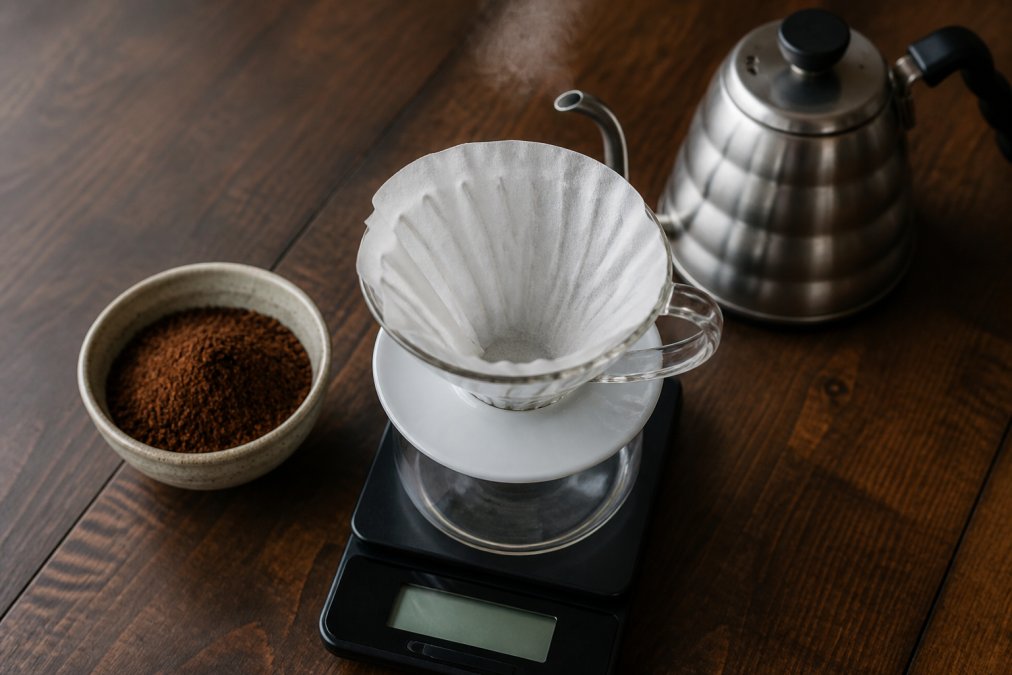
That number is the lever most people never touch. They add more scoops, guess at the water, and wonder why the cup tastes thin.
How to Measure by Weight, Not Scoops
A scoop is not a measurement. Bean density, grind size, and how you level the scoop all change the actual dose.
| Brew Style | Coffee | Water | Strength |
|---|---|---|---|
| Standard drip | 1 g | 16 g | Medium |
| Strong drip | 1 g | 13 g | Bold |
| French press | 1 g | 12 g | Full body |
| Cold brew concentrate | 1 g | 8 g | Very strong |
The Best Coffee Grind Size for Strength
The best coffee grind size for strength is the one that lets water reach the center of every particle in the time your brewer allows. Grind is not a strength dial you turn up or down; it is a surface-area control. Finer particles expose more surface to water, so flavor and caffeine dissolve faster. Coarser particles expose less, so the same brew time pulls less out.
Match the Grind to the Brewer, Then Dial It In
Start with the brewer's baseline, then adjust one step at a time based on taste:
- French press: coarse, like sea salt
- Drip: medium, like table salt
- Pour-over: medium-fine
- Moka pot: fine, like espresso
- Cold brew: very coarse
Why Particle Consistency Matters More Than the Setting
A burr grinder produces particles of similar size, so they all finish extracting at roughly the same moment. A blade grinder chops unevenly, producing a mix of boulders and dust. The dust over-extracts and turns bitter while the boulders under-extract and stay sour, so the same cup tastes both at once. That is the single most common reason a home brewer cannot dial in a strong cup that still tastes clean.
Grind Size and Caffeine
Finer grinds extract caffeine faster, so a fine grind can push more caffeine into the cup in a shorter window. But caffeine content is driven mostly by dose and bean, not grind. If you want more caffeine, add coffee, not dust. Chasing caffeine through grind alone mostly buys you bitterness.
Water Temperature and Brew Time: The Two Levers Most People Ignore
Water temperature and brew time decide how much flavor actually lands in your cup. Get these wrong and no ratio will save you. Most guides stop at "use 195-205°F and steep for four minutes." That is a starting point, not an explanation. Here is what is actually happening.
The Extraction Curve, in Plain Terms
When hot water hits coffee grounds, it dissolves compounds in a predictable order. First come the fruity and bright acids, then the sugars and caramel notes, then the bitter and drying compounds. Under-extraction means you stopped before the sugars arrived. Over-extraction means you kept going past them into the harsh end.
Target Numbers That Actually Work
- Water temperature: 195-205°F (90-96°C)
- Drip: 4-5 minutes total
- French press: 4 minutes steep, then press
- Pour-over: 2-3 minutes
- Cold brew: 12-18 hours in the fridge
Light roasts are denser and resist extraction, so they often benefit from the hotter end of that range. Dark roasts are more porous and give up their compounds quickly, so they often do better at the cooler end. If your dark roast tastes ashy, drop the temperature before you change anything else.
Troubleshooting by Taste
Use the cup itself as your instrument:
- Sour, sharp, or tea-like: under-extracted. Raise the temperature a few degrees or extend the brew time by 30 seconds.
- Bitter, dry, or harsh: over-extracted. Lower the temperature or shorten the brew time.
- Weak and sour at the same time: the grind is too coarse and the dose is too low. Fix the dose first, then the grind.
- Strong but bitter: the ratio is fine, the extraction is dirty. Coarsen the grind or cool the water.
Change one variable per brew. If you change temperature, time, and grind at once, you learn nothing.
Why This Matters for Strength Specifically
A strong cup is not just more coffee. It is a cup where the dose is high and the extraction is clean. If you tighten the ratio without fixing temperature and time, you get a concentrated version of a flawed cup, which tastes worse, not stronger. Dial in extraction first, then push the ratio.
Pick a Brewing Method That Delivers Strength
Immersion and pressure methods deliver the boldest cups. Pour-over and drip give you more control but cap out lower on body.
Immersion Brewing: French Press and Cold Brew
French press and cold brew are the easiest routes to a strong morning coffee. Both soak the grounds fully, so extraction is even and forgiving.
Pour-Over and Moka Pot: Strength With Control
Pour-over rewards attention. You control the pour, the temperature, and the timing, so you can dial in exactly the strength you want.
How to Reduce Coffee Bitterness Without Losing Strength
To reduce coffee bitterness without losing strength, fix the extraction instead of adding milk or sugar. Bitterness almost always means over-extraction, not too much coffee.
Try these fixes in order:
- Coarsen the grind by one step
- Lower the water temperature slightly
- Shorten the brew time by 30 seconds
- Check your ratio. Too little coffee can taste bitter too
Caffeine Content vs. Perceived Strength: What Actually Wakes You Up
Perceived strength and caffeine content are not the same thing. A dark, heavy cup can taste powerful and still carry less caffeine than a lighter roast.
Frequently Asked Questions
Does a finer grind make coffee stronger?
A finer grind increases the surface area the water touches, so more flavor and caffeine compounds dissolve into the cup. That said, going too fine causes over-extraction, which brings out harsh, bitter notes instead of a clean, bold flavor. For drip and pour-over, aim for a medium-fine grind; for French press, stay coarse so the grounds don't clog the filter. The best coffee grind size for strength is the finest setting your brewing method can handle without stalling or turning bitter.
How does water temperature affect coffee strength?
Water between 195°F and 205°F extracts flavor and caffeine efficiently. Below that range, extraction slows and the cup tastes weak and sour. Above it, you pull out bitter compounds that mask the coffee's natural sweetness. If you don't have a temperature-controlled kettle, boil water and let it sit for 30 to 45 seconds before pouring. That quick pause lands you in the right window without any extra equipment.
What is the 15-15-15 rule for coffee?
The 15-15-15 rule is a simple memory aid: a 1:15 coffee-to-water ratio, a 15-setting grind on a standard burr grinder, and a 15-minute steep for cold brew. It works as a starting point, not a fixed law. For hot brewing, most people land closer to a 4-minute brew time. Treat the rule as a baseline, then adjust one variable at a time until the cup tastes the way you want.
How do I make strong morning coffee without it turning bitter?
Strength and bitterness come from different places. Strength is about how much dissolved coffee solids end up in the cup; bitterness comes from over-extracting those solids. To get a bold cup without the harsh finish, use more coffee rather than a longer brew time, keep water between 195°F and 205°F, and grind consistently with a burr grinder. If the cup still tastes bitter, coarsen the grind slightly or shorten the steeping time by 20 to 30 seconds.
Brewing a strong cup every morning comes down to a few things you control: fresh beans, an accurate ratio, the right grind, and water that isn't too hot. Nail those and strength stops being a guessing game. Johnny D's Brew roasts every order to ship fresh, offers free US shipping on coffee and tea, and gives you blends built for real caffeine, not just dark color. Find your perfect roast and start your mornings with a cup that actually delivers.