

How to Tell If Coffee Is Fresh Roasted: 2026 Guide
Table of Contents
- Why Fresh Roasted Coffee Tastes Different: Degassing and CO2
- Step 1: Check the Roast Date and Packaging
- Step 2: Run the Coffee Bloom Test
- Step 3: Inspect Beans Visually for Freshness Cues
- Step 4: Smell and Taste for Aroma and Flavor Profile
- How to Store Coffee Beans Properly
- Coffee Shelf Life After Roasting: What to Expect
- Frequently Asked Questions
Last Updated: September 25, 2026
Why Fresh Roasted Coffee Tastes Different: Degassing and CO2
Fresh roasted coffee tastes different because of carbon dioxide. Right after roasting, beans hold a burst of CO2 inside them. That gas escapes slowly over the next several days, a process called degassing.
| Signal | Fresh | Stale |
|---|---|---|
| Roast date | Within 2-4 weeks | 2+ months old |
| Bloom | Puffs and bubbles | Little to no reaction |
| Surface | Matte (or glossy on dark roasts) | Dry, faded, or oily-slick |
| Aroma | Sweet, bright, complex | Papery or flat |
Step 1: Check the Roast Date and Packaging
The roast date is the single most useful number on any bag. A "best by" date tells you almost nothing. Roasters set those dates loosely, and they can fall months after roasting.
What a Roast Date Actually Tells You
A roast date tells you how far the beans are into their degassing window. Most coffee hits peak flavor roughly 4 to 14 days after roasting. That range shifts with roast level, which we cover below.
Packaging Technology: Valve Bags vs. Vacuum Seals
Packaging decides how well beans survive shipping and shelf time.
- Valve bags: A one-way valve lets CO2 escape without letting air in. This is the standard for specialty coffee.
- Vacuum seals: Air is pulled out and the bag is sealed tight. Great for long storage, but the beans stop degassing and can taste flat when opened.
- Plain bags: No valve, no seal. Air gets in, and oxidation starts fast.
Step 2: Run the Coffee Bloom Test
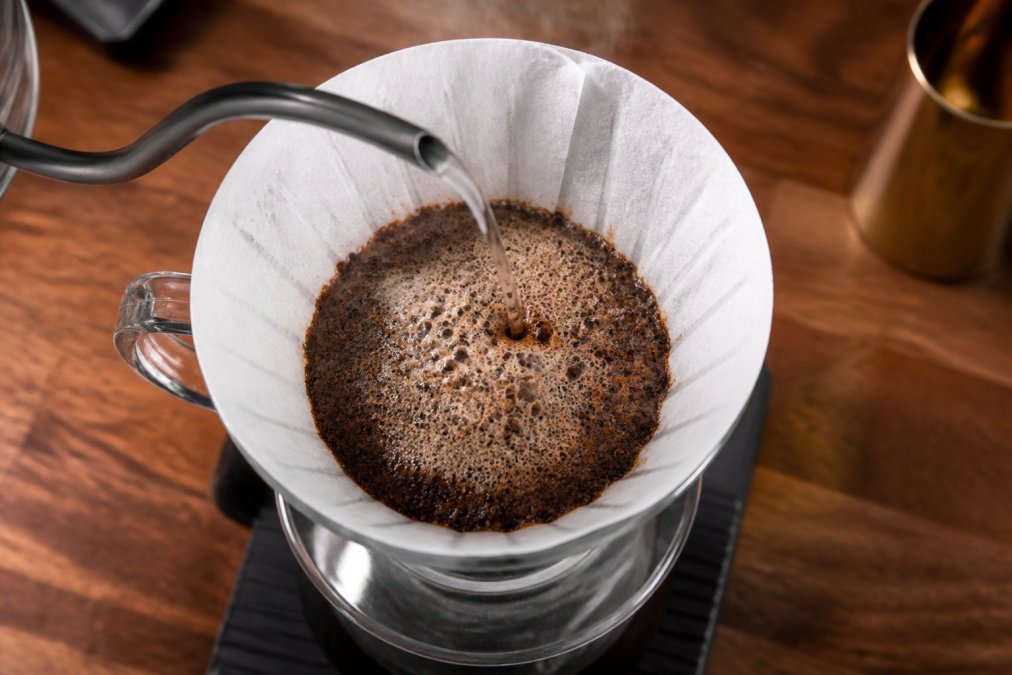
The bloom test is the fastest way to judge freshness in real time, and it is the only check that gives you an answer in under a minute. Grind a small amount of coffee, pour hot water over it, and watch.
What a Strong vs. Weak Bloom Looks Like
A strong bloom means active degassing, which points to a recent roast. Here is how to read the reaction:
- Strong bloom: The bed rises noticeably, bubbles vigorously for 20-40 seconds, and forms a thick, domed crust. This is typical of beans 2-14 days off roast.
- Moderate bloom: A gentle rise with some bubbling that settles within 10-15 seconds. Common around 3-5 weeks off roast.
- Weak or flat bloom: Little to no rise, few bubbles, and the grounds just sit there. This usually means the beans have already released most of their gas, often 6+ weeks old, or beans that were never very fresh to begin with.
The Variables That Skew the Test
The bloom test is not perfect, and treating it as a verdict is the most common mistake. Three variables change the size of the reaction:
- Grind size. Finer grinds expose more surface area and release gas faster, producing a bigger bloom even from older beans. Coarse grinds bloom less dramatically even when fresh.
- Water temperature. Hotter water (just off boil, around 200-205°F) drives off CO2 more aggressively than lukewarm water. A weak bloom with cool water does not necessarily mean stale beans.
- Dose and vessel. A small dose in a wide mug spreads thin and blooms weakly; the same dose in a narrow pour-over cone concentrates the reaction. Use the same setup each time if you want to compare bags.
Why the Bloom Test Beats the Date Stamp Alone
A roast date tells you when the clock started. The bloom tells you how far the clock has actually run. Beans stored poorly can bloom weakly at two weeks; beans in a sealed valve bag can bloom strongly at four. Running the bloom test on a new bag is the quickest way to confirm what the label claims, and to decide whether to brew it now or finish it fast.
Step 3: Inspect Beans Visually for Freshness Cues
Your eyes catch what a date stamp can miss. Pour a few beans into your palm and look closely.
Oiliness, Gloss, and Color by Roast Level
Oiliness means different things at different roast levels.
- Light roasts: Should look dry and matte. Surface oil on a light roast often means the beans are old.
- Medium roasts: A slight sheen is normal. Heavy oil is a sign of age.
- Dark roasts: Oily and glossy from day one. This is normal, not a flaw.
That last point trips people up. Dark roast beans are oily because the longer roast pulls oils to the surface. Do not read oiliness on a dark roast as a freshness problem.
Bean Density and Moisture Content
Fresh beans feel dense and heavy in your hand. As beans age, they lose moisture and get lighter. A handful of stale beans feels almost hollow.
Step 4: Smell and Taste for Aroma and Flavor Profile
Your nose is the most sensitive freshness tool you own. Open the bag and breathe in before you brew.
- Acidity: Fresh coffee has a lively, bright edge. Stale coffee tastes dull.
- Bitterness: Old beans often turn harsh and bitter as oils break down.
- Finish: A fresh cup lingers with flavor. A stale cup fades fast.
How to Store Coffee Beans Properly
Storing coffee beans properly comes down to four enemies: air, moisture, heat, and light. Beat all four and your beans stay fresh for weeks.
Here is a storage routine that works:
- Keep beans in an airtight container with a one-way valve if possible.
- Store the container in a cool, dark cabinet, not the fridge.
- Buy whole beans and grind right before brewing.
- Skip the freezer unless you seal beans in a vacuum bag for long-term storage.
- Buy in small amounts you will finish within two to four weeks.
Coffee Shelf Life After Roasting: What to Expect
Coffee shelf life after roasting depends on the roast level, the packaging, and how you store it. There is no single number that fits every bag, but there is a curve, and understanding it lets you predict freshness instead of guessing.
The Degassing Curve: Why Freshness Is a Window, Not a Line
Right after roasting, beans are full of CO2. Over the next several days, that gas escapes. The curve looks like this:
- Days 0-2: Too much CO2. The gas blocks water from reaching the grounds, so brews taste flat, uneven, or foamy. This is why many roasters rest beans before shipping.
- Days 3-14: The sweet spot for most roasts. CO2 has dropped enough to let water extract properly, but the volatile aroma compounds are still intact.
- Days 15-30: Flavor begins to flatten. Aromatics fade first, then acidity, then body. Beans are still drinkable but no longer at their best.
- Days 30+: Oxidation dominates. Oils go rancid, and the cup turns papery, cardboard-like, or harsh.
Peak Flavor Window by Roast Level
Different roasts peak at different times. This is one of the most misunderstood parts of coffee freshness.
| Roast Level | Peak Window | Notes |
|---|---|---|
| Light | 7-14 days | Needs longer to degas, holds flavor well |
| Medium | 4-10 days | Balanced window, most forgiving |
| Dark | 2-7 days | Oily surface, peaks fast, fades fast |
How Packaging Changes the Clock
Packaging is the variable most drinkers ignore, and it can add or subtract weeks from shelf life:
- One-way valve bags: The standard for specialty coffee. The valve lets CO2 escape without letting oxygen in, so beans keep degassing without oxidizing. This is the best-case scenario for a 2-4 week window.
- Nitrogen-flushed valve bags: Some roasters flush the bag with nitrogen before sealing, displacing oxygen entirely. This can extend peak flavor by several days to a week beyond a standard valve bag.
- Vacuum-sealed bags: Air is pulled out and the bag is sealed tight. Great for long-term storage, but the beans stop degassing and can taste flat when first opened. Give them a day or two to breathe after opening.
- Plain bags or tins: No valve, no seal. Air gets in, oxidation starts fast, and the window shrinks to days rather than weeks.
Home-Roasted Beans: A Different Curve
If you roast at home, your freshness curve looks different from store-bought beans. Home-roasted coffee often needs a longer rest, 3-7 days for light roasts, before it brews well, because the roast profile is less uniform and degassing is more erratic. But once rested, home-roasted beans can peak later and hold flavor longer than commercial beans, since they have not spent days in shipping and warehouse storage.
Frequently Asked Questions
How long after roasting is coffee at its peak flavor?
Fresh roasted coffee hits its peak flavor roughly 3 to 14 days after the roast date. During the first 24 to 48 hours, beans release carbon dioxide in a process called degassing, which can make extraction uneven. After that window, the flavor profile stabilizes. Lighter roasts often peak closer to 7 to 14 days, while darker roasts peak around 3 to 7 days. Beyond 3 to 4 weeks, oxidation gradually dulls aroma and acidity.
What is the coffee bloom test and does it indicate freshness?
The coffee bloom test involves pouring hot water over freshly ground coffee and watching for a bubbling, expanding foam. That reaction comes from carbon dioxide escaping the grounds. A vigorous bloom signals the coffee still holds trapped CO2, which means it was roasted recently. A weak or flat bloom suggests most gas has already escaped, pointing to older or stale beans. It is one of the easiest at-home checks for fresh roasted coffee.
How do I store coffee beans properly to keep them fresh?
Store coffee beans in an airtight container away from light, heat, and moisture. A ceramic or opaque canister with a tight seal works well. Keep the container in a cool, dark cabinet rather than the refrigerator, since temperature swings and odors can affect the beans. For longer storage, consider freezing in a vacuum-sealed bag. Only grind what you need right before brewing, because ground coffee loses its aroma and flavor much faster than whole beans.
What are the signs that coffee beans have gone stale?
Stale coffee beans show several telltale signs. They lose their glossy or oily sheen and appear dull and dry. The aroma turns papery, hollow, or musty instead of rich and punchy. When brewed, the cup tastes flat, with muted acidity and a lingering bitterness that lacks complexity. The bloom test produces little to no bubbling. If your beans are more than 4 to 6 weeks past the roast date, these signs are likely to appear.